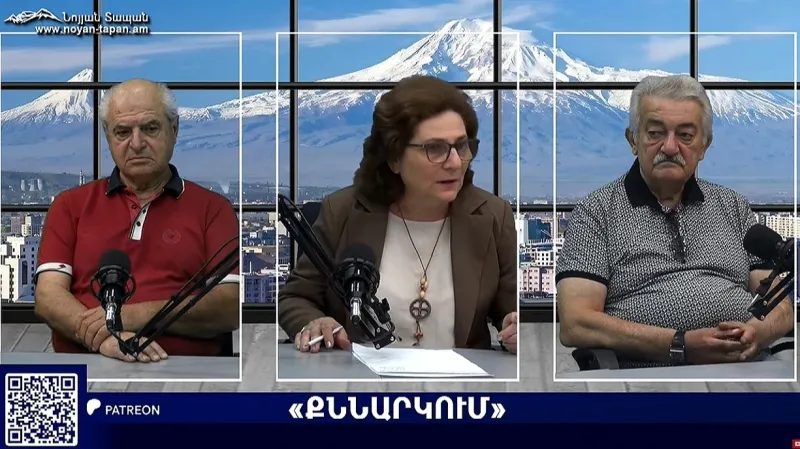
YEREVAN — In a fiery broadcast hosted by Noyan Tapan, political analysts and public figures gathered to address a critical national debate: the strategic presence of Russia’s 102nd Military Base in Gyumri and the broader question of Armenia’s geopolitical posture. Featuring Doctor of Political Sciences Arkadi Vardanyan and former Supreme Council deputy and public activist Azat Arshakyan, the conversation dissected recent remarks by business mogul and politician Samvel Karapetyan, who warned that removing the Russian base would leave Armenia “masterless” and defenseless.
The discussion opened with host-moderated commentary on Karapetyan’s assertion that removing Russian troops would lead to abandonment or immediate Turkish dominance.
Azat Arshakyan offered a blunt critique of this mindset, arguing that viewing the presence of foreign troops as an indispensable “master” reflects a psychology of bondage. “Samvel Karapetyan speaks from the perspective of a Russian citizen deployed to represent Russian interests,” Arshakyan declared. “Those who serve Russian interests will indeed feel ‘masterless’ without the base, because the 102nd base is an occupational military presence. Ever since the Russian Empire invaded and seized Armenia in 1920, it has served its own interests, its agents, and its servants. If the base leaves, Armenia does not become defenseless—it finally becomes independent, no longer a governorate or colony.” Arshakyan added that expecting a master is the language of an unfree person.
Turning to the economic and strategic burdens of the base, Dr. Arkadi Vardanyan used a stark metaphor: “If you do not pull a thorn out of your finger, over time the finger will fester. The sooner you remove it, the healthier the body becomes.” Dr. Vardanyan highlighted a unique anomaly in Armenia’s agreement with Moscow: “Armenia is the only post-Soviet country that maintains a Russian military base largely at its own expense. In all other countries, Russia pays significant rental fees.” He suggested that if Armenia were to demand full retroactive rent for all the years the base has operated, those funds would constitute a massive investment into Armenia’s national industry.
The panel extended the debate to historical grievances and transactional diplomacy between Moscow and Ankara. Arshakyan stressed that the Russian military presence has historically functioned as currency in Russian-Turkish bargains rather than a defense shield. “Russia gained immense stability by yielding Armenian territories like Nakhijevan and Kars,” Arshakyan noted, pointing to early 20th-century treaties where Armenian land was used as small change to secure Russian borders and maritime rights. He called for a comprehensive bilateral or international review to balance the historical ledger: “We should establish a commission—even utilizing modern artificial intelligence centers—to calculate the exact political, economic, and strategic balance of our historical relationship. What benefit did we give the Russian Empire, and what did we receive in return?”
Addressing fearmongering regarding border threats and border security, Dr. Vardanyan emphasized that true national dignity relies on self-determination and the strength of the diaspora. “With over 10 million Armenians worldwide, we are not a small nation. Our priority must be consolidating our global diaspora and proving to figures like Samvel Karapetyan that we are not abandoned stray dogs,” Vardanyan asserted.
As international pressure and shifting global dynamics continue to alter Moscow’s regional footprint, the dialogue hosted by Noyan Tapan highlighted a growing demand among Armenian intellectuals for sovereign accountability, financial audit of military arrangements, and a departure from total geopolitical reliance.
Կարդացել են
անգամ