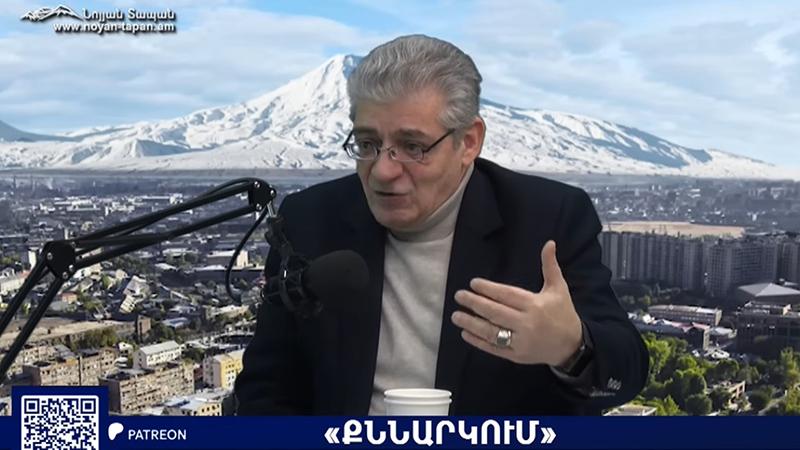
For decades, the study of ancient Armenian history and culture has been shrouded in what many scholars describe as an “invisible hand” of political and scientific bias. Recently, on a captivating episode of the Noyan Tapan discussion program, Armenologist and culturologist Artur Armin shed light on this very issue, presenting compelling linguistic and archaeoastronomical evidence that challenges the conventional narrative surrounding the ancient Kingdom of Van, widely known as Urartu.
Hosted by Tigran Harutyunyan, the Noyan Tapan broadcast tackled the deeply entrenched misconceptions about Armenia’s ancient past. The host highlighted how, during the Soviet era, political directives essentially mandated that a massive portion of Armenia’s cultural and historical heritage be detached and reclassified under the separate “Urartian” label.
Armin, who has dedicated over 30 years to studying Armenia’s oldest historical periods, concurred, tracing the issue back even further. He noted that roughly 150 years ago, a biased European academic consensus concluded that the Indo-European motherland must reside in Europe, thereby mischaracterizing Armenian as a language with only 8 to 9 percent Indo-European roots. “This meant that Armenians were not supposed to be indigenous, but had to come from somewhere else,” Armin explained. He further alleged that modern political actors, specifically Turkey, spend “tens of millions of dollars” annually in grants to Western institutions to fund and sustain this “newcomer” theory.
The Linguistic Illusion of an “Alien” Language
A major pillar of Armin’s argument rests on the deliberate misreading of cuneiform texts. Historically, researchers have treated the language of the Van Kingdom as an isolated, non-Armenian tongue. However, Armin points out that the cuneiform script is syllabic and ambiguous—a single wedge can represent multiple sounds, such as ‘L’, ‘Gh’, and ‘Zh’.
By selectively reading these symbols, biased scholars have obscured native Armenian words. Armin cited the work of linguist Sargis Ayvazyan, whose research into “Urartian Grammar” reveals that out of a corpus of roughly 543 deciphered Urartian words, an overwhelming 70 percent are actually native Armenian.
Armin provided a stark example of how textual interpretation is manipulated. If archaeologists were to unearth an ancient iron dagger with a cuneiform inscription reading “Sur”—the exact Armenian word for sword—certain foreign Urartologists, such as the renowned Italian scholar Mirjo Salvini, would deliberately read it as “Shuri” or “Shuli”. “Out of a desire that under no circumstances should it be read in Armenian, they read it as ‘shuli’ and it becomes the language of aliens,” Armin remarked, emphasizing that the reading of these ancient texts often relies merely on the “desire of the researcher”.
Similarly, he noted that the people of this ancient kingdom never called themselves “Urartians.” The cuneiform term “Biainili,” when read with a ‘V’ instead of a ‘B’, translates directly to “people of Van” (Vanetsi).
Reading the Stars: Mher’s Door and the Ancient Pantheon
Moving beyond linguistics, Armin introduced his groundbreaking research correlating ancient mythology with astronomy. He focused on the famous “Door of Mher” (Meher’s Door) rock inscription in Van, which meticulously lists the entire pantheon of gods and the specific number of bulls and sheep required for their sacrifices.
In his 2008 and 2020 publications, Armin demonstrated that the dimensions of the door and the exact quantities of the animal sacrifices form precise mathematical and geometric patterns, ultimately serving as a 100-year schematic ritual calendar.
To prove his theory, Armin cross-referenced the Mher’s Door inscription with the Babylonian “Mul.Apin,” a collection of roughly 5,000 texts that served as a comprehensive astronomical compendium for the ancient world. He also compared these texts to the “Shield of Anzav,” a highly decorated artifact discovered in 1995 that visually depicts these 12 deities in the exact sequence listed on Mher’s Door.
Armin discovered that the gods on Mher’s Door are not mere mythological figures, but rather representations of constellations and planets that marked the ancient calendar. The first four gods listed correspond perfectly to the constellations that defined the solstices and equinoxes thousands of years ago: Aquarius, Leo, Taurus, and Scorpio.
Constellations That Speak Armenian
The most staggering revelation presented by Armin is that the names of these astral deities in the “Urartian” pantheon are definitively Armenian.
The Raven: Where the Babylonian text lists the constellation Corvus as “Uga,” the Mher’s Door inscription uses “Agrav”—the exact Armenian word for raven.
Haldi / Haght: The supreme Urartian god Haldi, Armin argues (echoing linguist Vahan Sargsyan), should be read as “Haght”. In the Babylonian Mul.Apin, this corresponds to the “Gula” constellation, meaning “huge” or “giant”—a direct semantic match to the Armenian “Haght”.
Saturn / Libra: According to ancient texts, the planet Saturn and the constellation Libra were referred to by the same name. In the Van pantheon, it is inscribed as “Yereva,” which corresponds to “Yerevak,” the historical Armenian name for the planet Saturn.
Venus / Astghik: The deity representing the planet Venus is written as “Zard” (meaning ornament), which linguist Gevorg Jahukyan confirmed is an ancient root for “star,” directly tying to the Armenian goddess of love and the morning star, Astghik.
“It is so obvious,” Armin concluded. “It cannot be a pantheon of some other ethnic group, where all the names of the gods must be Armenian. It means that whole [alien] theory collapses once again”.
For Armin, defending the true history of the Van Kingdom is not just an academic exercise, but a vital matter of national security. The Kingdom of Van encompasses roughly 300 years of history that is an “inseparable part” of the Armenian legacy.
“National identity and national history are located in the most fundamental place,” Armin warned the Noyan Tapan audience. “And if you want to collapse that nation, you begin to distort and falsify its history… We must preserve our identity, which is the greatest bastion, the greatest fortress connected with our national identity, statehood, and the collective soul of the nation”.