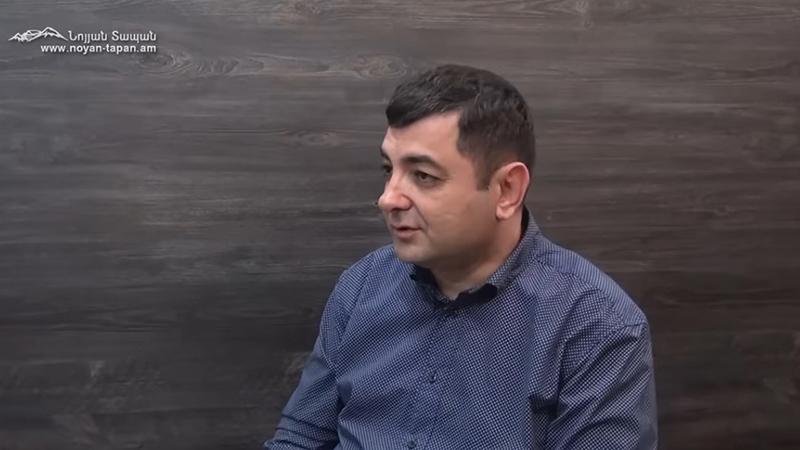
In a wide-ranging and sobering interview hosted by Noyan Tapan, political analyst Davit Stepanyan, an expert at the Armenian Institute of International and Security Affairs, dissected the complex web of geopolitical shifts currently reshaping the South Caucasus. From the volatile transition in Iran to the internal “War vs. Peace” rhetoric dominating Armenian politics, Stepanyan offered a clinical assessment of the risks facing the Armenian state.
The conversation began with the confirmed death of a high-ranking Iranian official, a development Stepanyan viewed through the lens of a much larger confrontation. While the analyst clarified he is not an Orientalist, he placed the event within the “global war” for influence between China and the United States.
“Iran is a hub in the Greater Middle East that must either be neutralized, weakened, or made to work for U.S. interests,” Stepanyan noted. He argued that the primary U.S. objective is to extract Iran from China’s economic orbit—specifically its energy resources—while Israel views the Iranian state’s very existence as an existential threat.
For Armenia, the stakes of Iranian stability are immense. Stepanyan outlined two primary scenarios: a “Syrianization” of Iran involving a protracted civil war—which he termed a “negative scenario” that could bring Islamic extremism to Armenia’s doorstep—and a rapid transition to a pro-American government. Surprisingly, he cautioned that even a pro-Western Iran could jeopardize Armenia’s strategic transit projects, such as the North-South corridor, as new, more efficient routes through Turkey and Turkmenistan might become prioritized by Washington.
Domestic Politics: The “Peace Party” Narrative
Turning to the domestic front, Stepanyan addressed Prime Minister Nikol Pashinyan’s recent framing of the political landscape, where the ruling Civil Contract party is presented as the sole “Party of Peace,” while all others are labeled the “Party of War”.
“What Nikol Pashinyan says differs from reality, much like the rhetoric of previous leaders also differed from the reality we saw after the 44-day war,” Stepanyan remarked. While he acknowledged that the path to peace is the only viable option for a small nation like Armenia, he rejected the notion that the ruling party holds a monopoly on the desire for stability.
He specifically highlighted the role of Russia, stating it is an “axiom” that Moscow is not interested in a final peace agreement between Armenia and Azerbaijan. He warned that any future “pro-Russian satellite” government in Yerevan would likely sabotage Western-backed peace initiatives through “under-the-table” maneuvers, similar to the recent legislative trends seen in Georgia.
Protocol Failures and Strategic Concessions
The interview also touched upon a controversial incident involving the dismissal of the Genocide Museum-Institute director following a visit by a high-ranking U.S. official. Stepanyan characterized the fallout as a “protocol failure” rather than a purely academic or political dispute. He argued that while no one can stop a scholar from writing about the Armenian Genocide or Artsakh, state officials must adhere to strict diplomatic instructions during high-level visits.
Finally, Stepanyan drew a sharp line between “political statements” and “strategic concessions”. He argued that rhetoric regarding transit roads is often part of a political conjuncture, whereas real concessions involve physical territory.
“For me, a concession would be the handover of Tigranashen, which has strategic significance,” Stepanyan emphasized, adding that the path to peace cannot involve further strategic losses. As Armenia enters an unofficial election cycle, Stepanyan’s analysis serves as a reminder that the nation’s future is being written not just in Yerevan, but in the corridors of power in Washington, Beijing, and Tehran.