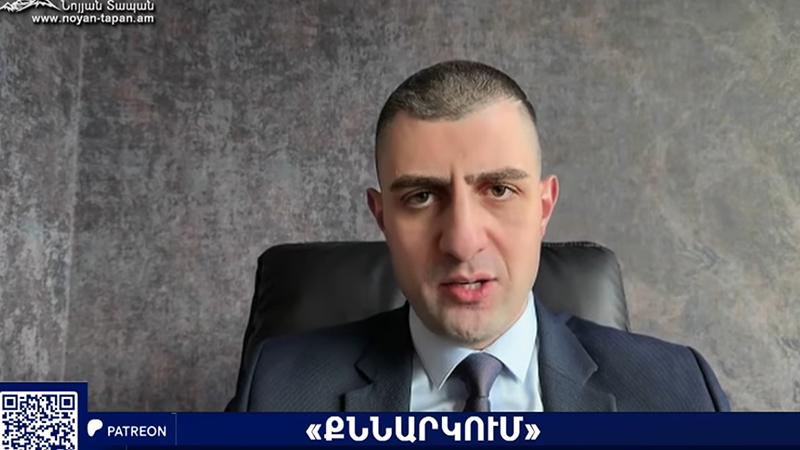
As the geopolitical tectonic plates of the South Caucasus continue to shift, Armenia finds itself at a critical juncture, balancing immediate security threats with a long-term vision of European integration. In a comprehensive interview hosted by Noyan Tapan, Georgy Tumasyan, a prominent specialist in international relations and public administration, provided a sobering yet strategic analysis of Armenia’s current position and the path toward Western alignment.
Speaking from Tbilisi, Tumasyan highlighted the evolving dynamics between Armenia and its neighbors, emphasizing that the era of relying on traditional security guarantees is rapidly closing. The discussion centered on a fundamental question: how can a nation under constant pressure transform its diplomatic and military architecture to ensure survival?
The “Cyprus Model” and European Security
One of the most compelling segments of the interview focused on the potential for Armenia to join the European Union. Tumasyan pointed to the historical precedent of Cyprus to illustrate that EU membership is not a magic shield, but a vital layer of modern defense.
“Even Cyprus, a member of the European Union, found itself under attack,” Tumasyan noted, referencing the complex security history of the Mediterranean island. However, he argued that for Armenia, the EU represents more than just a political club. “If Armenia becomes a member of the European Union, it is another opportunity to receive fresher weaponry, more powerful capabilities, and financial aid. It is a multi-layered prospect.”
This perspective shifts the conversation from EU membership being a distant economic goal to it being a functional necessity for national security. By integrating into the European framework, Armenia would gain access to institutional support systems that currently remain out of reach.
Diplomacy Under Constraint
The reality of Armenia’s current military and economic standing remains a focal point of Tumasyan’s analysis. He was candid about the limitations facing the Armenian government in its rhetoric and foreign policy.
“Armenia, in this situation, cannot afford to make aggressive statements or those based strictly on the projection of force,” Tumasyan remarked. This pragmatic “quiet diplomacy” is essential, he argues, while the country works to diversify its security partners and rebuild its internal strengths.
The guest suggested that while the desire for a more assertive stance is high among the public, the strategic reality demands a careful, calculated approach that avoids unnecessary escalation while simultaneously moving away from the sphere of influence that failed to protect Armenian interests in recent years.
The Regional Corridor and Georgia’s Role
The interview also touched upon the “Middle Corridor” and the vital role of Georgia as Armenia’s gateway to the West. Tumasyan’s insights from Tbilisi underscored the growing synergy between the two nations’ aspirations. As Georgia pursues its own Euro-Atlantic path, Armenia’s alignment with its northern neighbor becomes a strategic lifeline.
According to Tumasyan, the integration of the South Caucasus into European transit and energy networks is not just an economic project but a security one. The more “Europeanized” the region’s infrastructure becomes, the higher the cost of aggression for external actors.
A Multi-Layered Strategy for Survival
The overarching theme of the discussion hosted by Noyan Tapan was the necessity of “multi-layered” thinking. Tumasyan argued that Armenia must move beyond binary choices—East vs. West—and instead build a robust network of functional dependencies with democratic allies.
“Yes, it is multi-layered,” Tumasyan concluded, referring to the complex web of financial, military, and diplomatic reforms required. The road to Brussels is long and fraught with regional obstacles, but in the eyes of experts like Tumasyan, it may be the only path that offers a sustainable future for Armenian sovereignty.
As Armenia continues to navigate these turbulent waters, the insights provided during this session serve as a roadmap for understanding the country’s pivot: a move defined not by aggression, but by a sophisticated search for modern, reliable, and European-aligned stability.