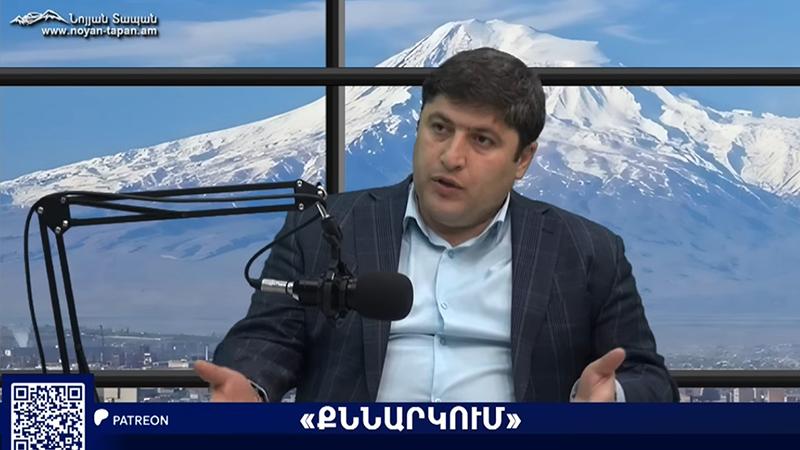
In a recent in-depth discussion hosted by Noyan Tapan, sociopolitical analyst and PhD in Sociological Sciences, Hayk Trunyan, offered a sobering assessment of the escalating tensions between the United States and Iran. The conversation delved beyond the immediate military maneuvers, exploring a global landscape where traditional kinetic warfare is being upended by asymmetric strategies and economic interdependencies that threaten the very foundations of global food and financial security.
The Mathematical Science of War
Trunyan began by challenging the strategic clarity of the U.S. approach. “War is a mathematical science where everything must be precise, and the most important thing is to clearly define the goal,” he stated. According to his analysis, the United States has struggled to maintain a consistent objective, vacillating between regime change, halting nuclear research, and the destruction of the Iranian military.
This lack of a singular, defined purpose, Trunyan argues, has led to a costly stalemate. He noted that while the U.S. has utilized nearly 800 Patriot missiles in the region—significantly more than the 600 used in the Ukraine conflict over several years—the high cost of these operations is beginning to stir internal dissent within the U.S. political landscape.
Asymmetry and the Economic Ripple Effect
While the U.S. conducts a “kinetic” war, Iran has spent 70 years preparing for “irregular” or asymmetric warfare. Instead of direct strikes on American soil, the strategy focuses on hitting U.S. partners and vital infrastructure.
The consequences of this strategy are already being felt globally:
Agricultural Crisis: Strikes on logistics hubs in Kuwait have disrupted the supply of nitrogen and carbonate fertilizers. This hits global agriculture directly, echoing the disruptions seen during the 2022 Russia-Ukraine conflict.
Financial Instability: Arab stock markets, once seen as deep and secure havens for international investment, are currently in a state of profound crisis.
Logistics Collapse: The image of regional hubs like Dubai, which rely heavily on air and sea logistics, has been severely damaged within just weeks.
“The U.S. looks at it from the angle of a regime they dislike; Iran looks at it as an asymmetric direction to strike at American partners,” Trunyan explained.
The Illusion of Victory
One of the most provocative points raised during the Noyan Tapan broadcast was the potential for a “declared victory” that fails to end the conflict. Trunyan suggested that President Trump might eventually declare the war won by citing the death of high-ranking leaders or the delay of nuclear programs.
However, he warned that such a declaration would be hollow. “It’s not chaos; it’s an asymmetric management model,” Trunyan noted, describing how Iran has empowered local, decentralized units to make independent decisions. This network-based resistance means that even if central leadership is neutralized, sabotage and regional instability will likely persist, leading to a situation he predicts will be “worse than Iraq”.
A Shifting Global Order
The discussion concluded with a look at the broader geopolitical shift. Trunyan observed that the world is currently caught between two competing models of leadership: the U.S. attempt to spread democracy—while increasingly using authoritarian methods internally—and China’s overt promotion of an authoritarian management model.
As the U.S. finds it increasingly difficult to conduct a ground operation due to domestic risks and costs, the reliance on proxies and air strikes continues. For Trunyan, the current conflict is not just a regional skirmish but a fundamental test of whether traditional superpowers can effectively combat a decentralized, asymmetric opponent in an interconnected world.